
Tax Decision in Serbia (poresko rešenje): How to Get It, Read It and Pay
A tax decision in Serbia, in Serbian poresko rešenje, is the document by which the tax authority determines the annual amount of tax and social security contributions for a flat-rate entrepreneur (paušalac). It arrives exclusively in the electronic tax mailbox on the ePorezi portal; paper versions have not been mailed or issued at local tax branches since 2020. Until you open it, you do not know how much to pay or to which accounts, yet you are legally obligated to pay from day one.
And here lies the main trap. Logging into ePorezi requires an authentication tool, and in most cases, all of them are available only to individuals who already hold a residence permit. An entrepreneur without a residence permit ends up in a bind: tax is assessed, deadlines are ticking, but there is nowhere to view the decision. There is a way out, and it is straightforward — explained below.
This information is current as of 12 October 2026.
What this document is and when it arrives
A flat-rate entrepreneur does not pay a percentage of income, but rather a fixed amount calculated by the tax authority based on activity code, municipality, and several other parameters. The result of this calculation is the tax decision. An accountant is not needed for this, a flat-rate entrepreneur does not file an annual tax return, and the KPO book is kept for personal records and presented only upon request. Read more about the regime itself in our article on the flat-rate tax.
In practice, you receive not one document, but three: the income tax decision, the social security contributions decision, and a report explaining how the tax authority calculated your tax base. All three reside in the same place, under the "Poresko sanduče" section on ePorezi.
They arrive in two scenarios.
After registering a sole proprietorship. The tax authority generates the decision within several days after APR (the Business Registers Agency) registers you with the flat-rate taxation note. One crucial condition: the sole proprietorship must be active, not suspended (frozen). Decisions are not issued for a suspended business, and no tax accrues during the suspension period.
Every January. A new decision for the upcoming year. In 2026, the tax authority began releasing them on 19 January 2026, and that same year ready-to-use payment slips with QR codes were attached to the decisions for the first time.
Decisions also arrive unscheduled: if you changed your activity code or registered address, exceeded the flat-rate limit, switched to another tax regime, or resigned from a Serbian company where you were employed. Each such event results in a new document in your mailbox.
Why "I didn't open it" is no excuse
The decision is considered legally served on the day the tax authority deposits it into your mailbox. Not on the day you opened or viewed it. This is explicitly stated in the law on tax procedure and repeated in every decision.
From this follows a straightforward consequence. If you haven't checked your mailbox for three months, you have spent three months paying the wrong amount or not paying at all, and late payment interest is already accruing. That same mailbox receives audit summons, debt reminders, and decisions revoking flat-rate eligibility. That is why the mailbox should be checked not once a year, but monthly, before making your payment.
How to read the decision
There are three documents, all in Serbian, and most of the text consists of statutory legal citations. You can skip over those. Look at four essential things.
Monthly amount. In the income tax decision, there is a single figure. In the contributions decision, it is broken down into three components: pension, health, and unemployment insurance, each with its own amount. That makes four payments per month in total.
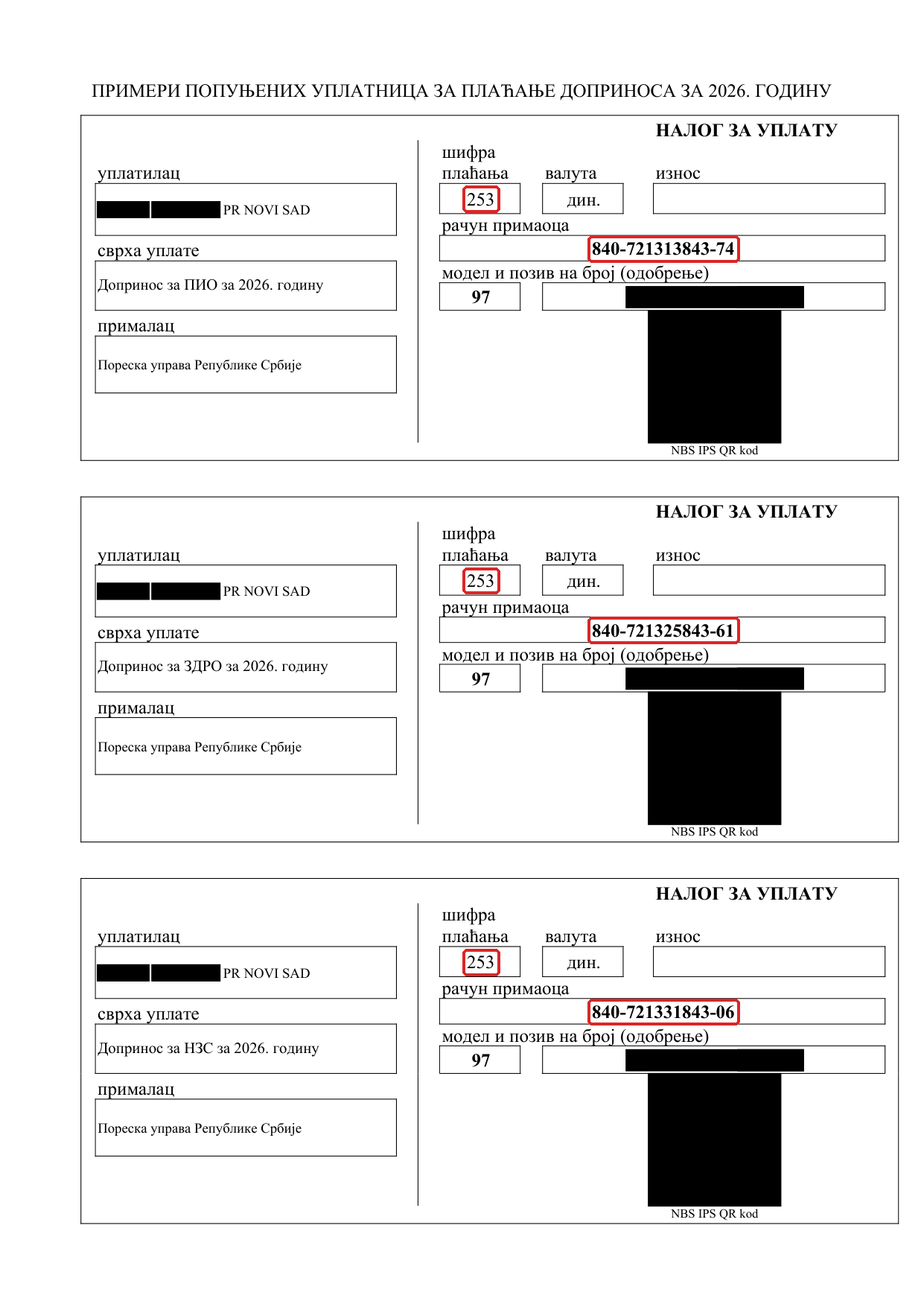
Payment accounts. Four separate treasury accounts, all beginning with 840. One for tax, three for contributions. They are identical for all flat-rate entrepreneurs nationwide, but a payment sent to the wrong account will not be credited.
Payment reference number. In the decision, it appears after the words "poziv na broj" next to model 97. This is your personal reference number with the tax administration; the system uses it to identify your payment. It is the same across all four monthly payments, but it changes every January. A payment made with an old number goes to the wrong place, requiring a formal application to locate and reallocate it.
Period. The month from which the specified amount takes effect. For a new sole proprietorship, this is the month of registration, and for an incomplete first month, the amount is proportional to the number of days.
If the contributions decision contains only two lines instead of four, you are most likely concurrently employed at a Serbian company or recently resigned from one. Two parts were paid for you by your employer. After leaving employment, you must submit a PPDP-1R application, and the tax authority will recalculate; a new decision will arrive in the same mailbox.
We break down a real example
Let's look at a real decision sent by the tax authority to our client. The sole proprietorship was registered in Novi Sad on 21 September 2026, activity code 5911 (video production), registered address Železnička 20. All three documents appeared in the mailbox on 22 September 2026, the day after registration. Personal data, numbers, and payment references on the scans have been obscured, the amounts are genuine, and the sections worth checking are circled in red.
It is easiest to start with the third document: the base calculation report. This is the only place showing exactly where your numbers came from.
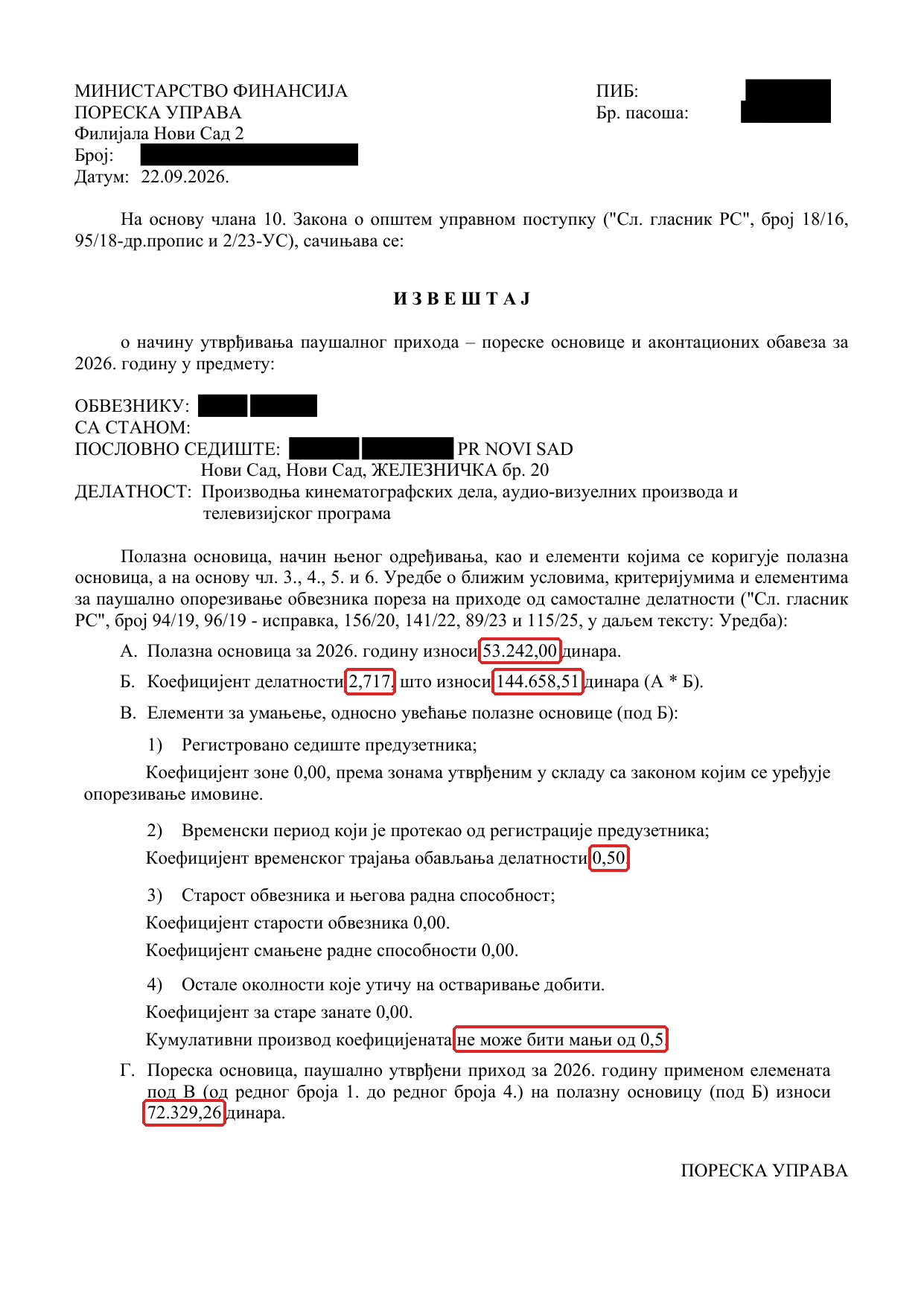
Here is how to read it. The starting base for all flat-rate taxpayers in 2026 is 53 242 dinars, which represents the national average salary. This is multiplied by the activity code coefficient; for code 5911, it is 2.717, yielding 144 658,51. Then come the adjustments: zero for municipality (for this code, the municipality does not affect the calculation), zero for age, zero for crafts, and 0.5 for the first year of business operation. The resulting tax base is 72 329,26 dinars per month. This is the base from which tax and contributions are calculated. Change the code, and everything will be recalculated; for most relocators, the remaining adjustments are zero.
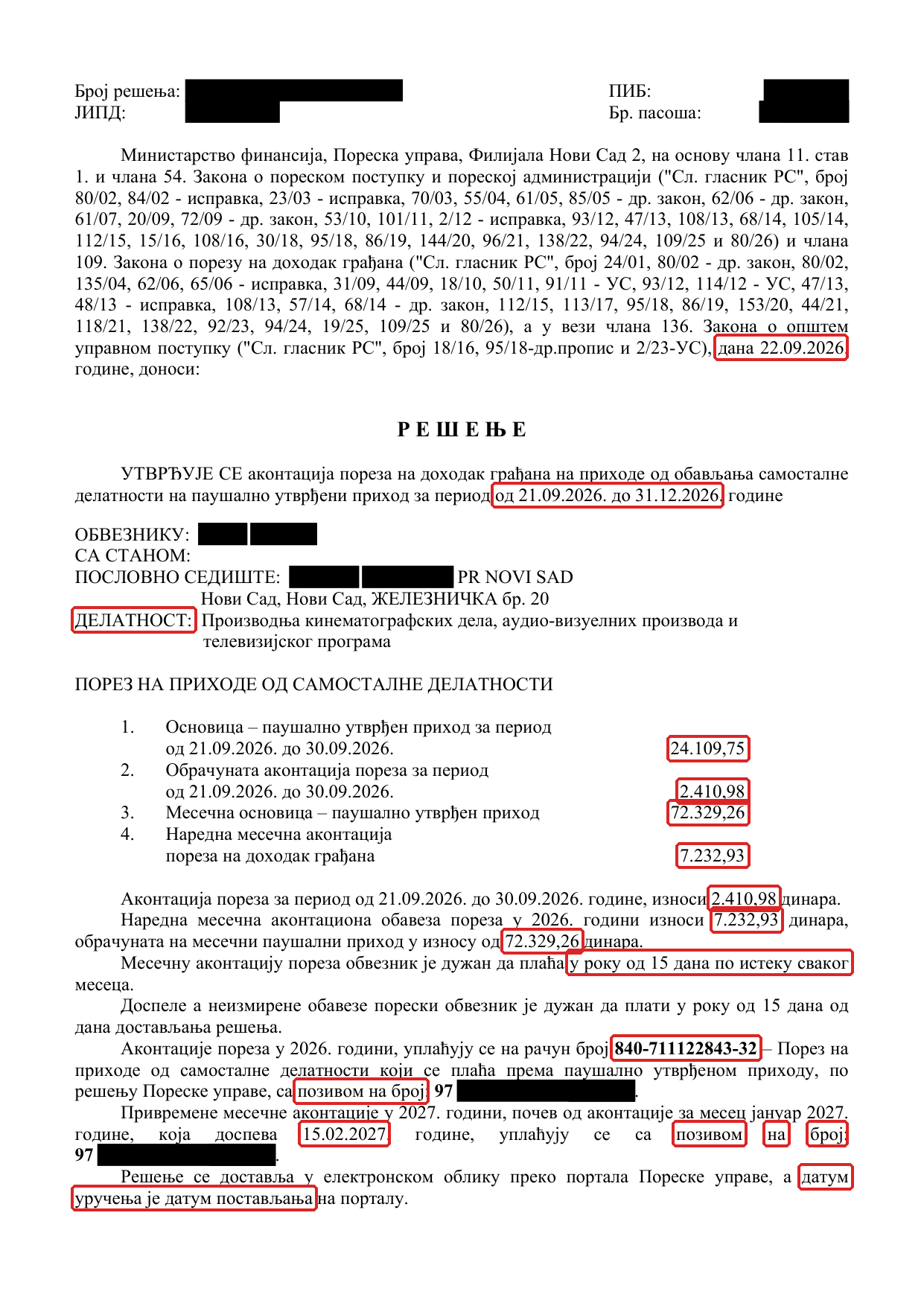
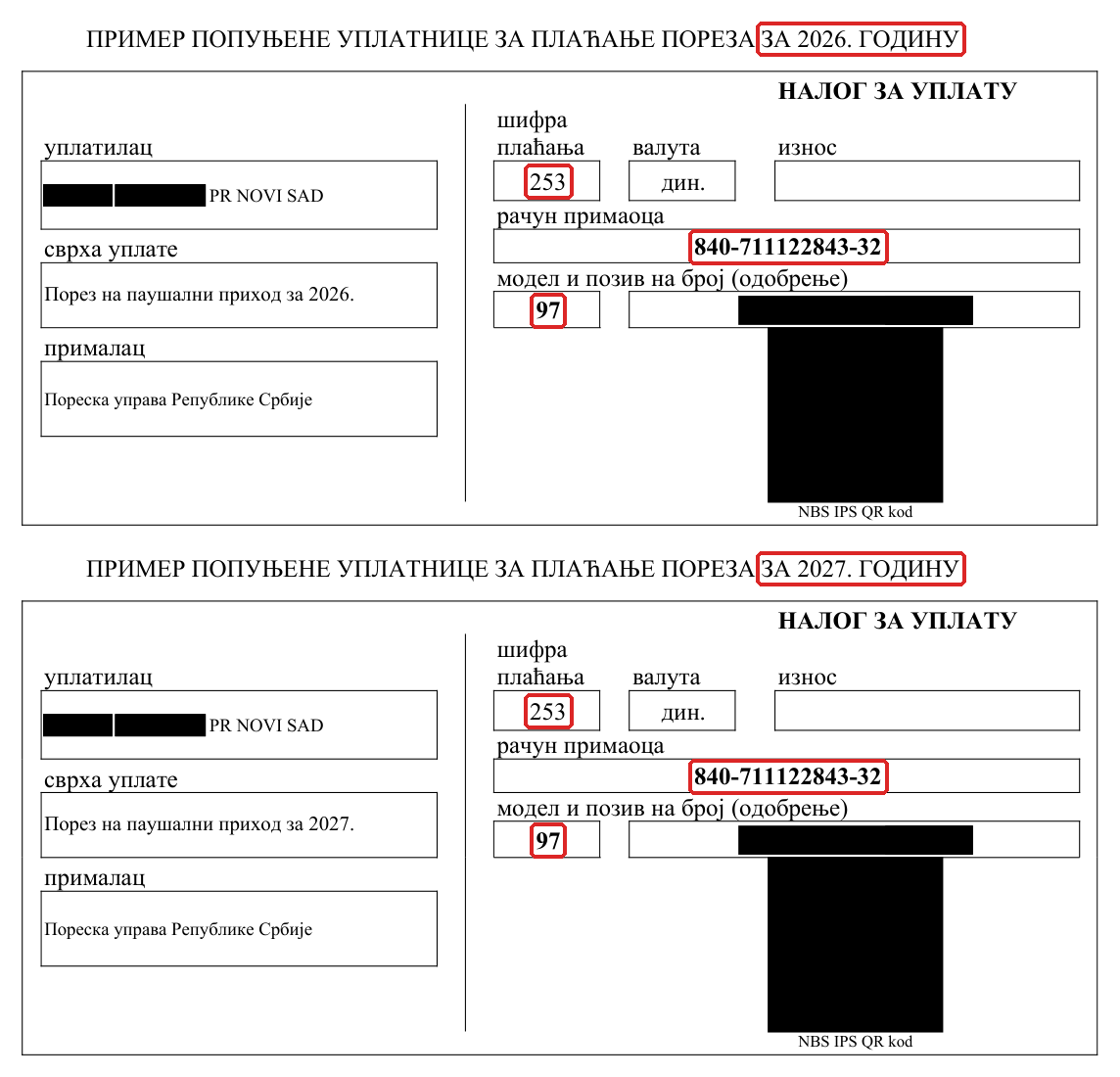
Next is the income tax decision. It lists two amounts: one for partial September and one for each full month, followed below by the payment account with the reference number for 2026 and a separate one for 2027.
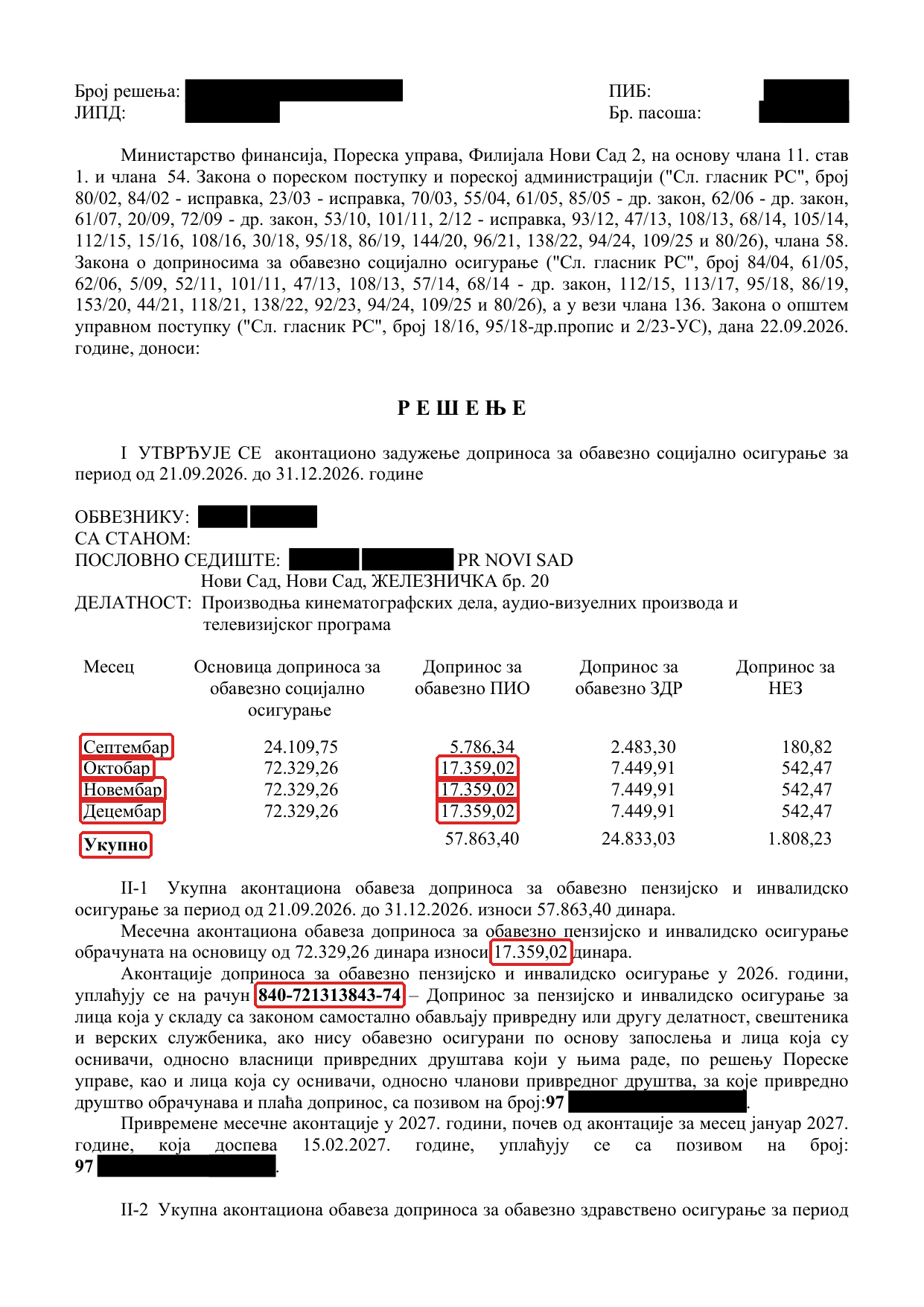
The contributions decision is longer because it consists of three parts and a monthly table through the end of the year.
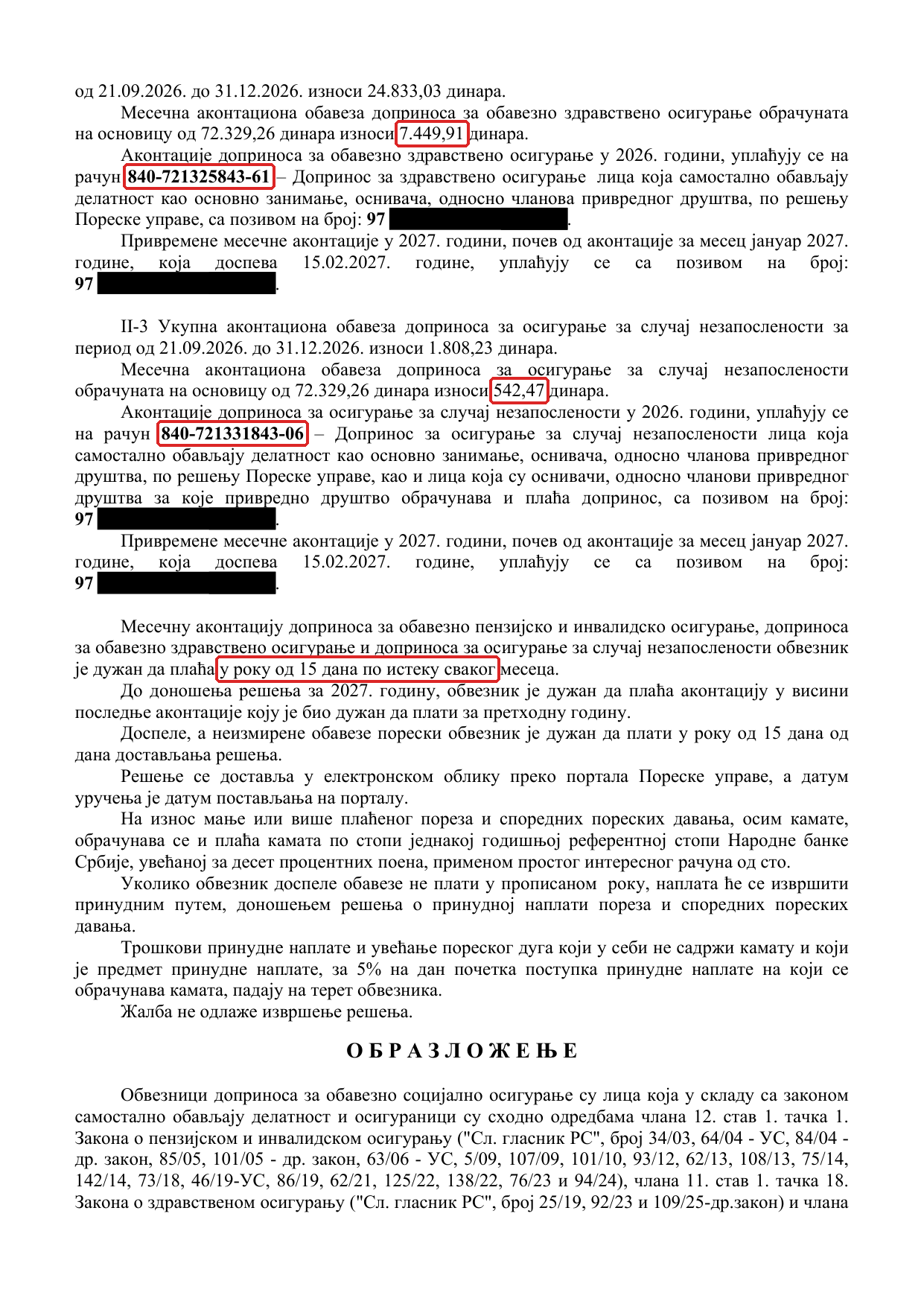
Putting it all together. In our example, the sole proprietor pays as follows:
| For the period 21–30 September | For each month from October | |
|---|---|---|
| Income tax | 2 410,98 | 7 232,93 |
| Pension contribution | 5 786,34 | 17 359,02 |
| Health contribution | 2 483,30 | 7 449,91 |
| Unemployment contribution | 180,82 | 542,47 |
| Total per month | 10 861,44 | 32 584,33 |
September is incomplete — ten days out of thirty — which is why it amounts to one third of the monthly sum. The decision is valid until 31 December; in January, a new one will arrive, calculated with the second-year coefficient.
And the most practical part: ready-to-use payment slips are attached on the final pages of each decision. They already show the account, payment code 253, model 97, and your payment reference number; you only need to enter the amount. Furthermore, there are two complete sets of slips: for 2026, and for 2027 with a different reference number, because starting with the January payment the reference number changes. Pay strictly according to the current year.
How to pay without mistakes
The deadline is uniform for everyone: by the 15th of each month for the preceding month. January is paid by 15 February, February by 15 March, and so on. If the 15th falls on a weekend or public holiday, the deadline moves to the next business day; in 2026, January was paid by 18 February 2026.
For a new sole proprietorship, there is an additional rule: all months accumulated prior to receiving the decision are paid within 15 days after its receipt. If you registered in March and saw the decision in May, you settle March and April before the end of May, with a separate payment for each month. You can also pay several months in advance: simply add up the sums for each of the four payments.
Four payment slips every month, as in the example above. The most common way people lose money is by sending the entire sum as a single payment to the income tax account. The funds will sit on that one account as an overpayment, while the other three accounts accumulate debt and late payment interest. Always separate them.
It is most convenient to pay through the banking app where your business account is held: scan the QR code from the payment slip, enter the amount, and confirm. Only business banking apps work with the QR code; doing so online from a personal account will not work.
There are four other places where people make mistakes most often.
Old reference number in January. People copy the previous year's payment slip, but the number has already changed. Pay December by 15 January using the old details, and pay January from 16 January onwards using the new ones.
Wrong payment code. The payment slips from the decision specify code 253, which is for online payment from a business account. If you pay in cash through an exchange office, post office, or bank counter, the code must be changed to 153.
Paying from a non-business account. Sole proprietorship tax is supposed to be paid from the sole proprietorship's business account. Paying in cash through an exchange office or from someone else's Serbian personal account will technically go through, and people do this at the start while the business account is not yet open. However, this is a grey area: the tax authority sees where the money came from and may raise questions during an audit. As soon as the account is opened, switch to paying from it.
Not saving confirmations. The bank shows the transfer immediately, but the tax authority registers the receipt with a delay of one or two days. Keep payment confirmations for at least a year: when renewing your residence permit or closing a sole proprietorship, you will need a tax clearance certificate (uverenje), and resolving discrepancies is much easier with paperwork in hand.
Late payments incur interest at the National Bank of Serbia reference rate plus ten percentage points per year, and as of 2026, a penalty starting from 50 000 dinars may be added. If you are late by only a few days, there is usually no fine, though interest will accrue in any case.
And good news: overpayments do not disappear. If you accidentally pay twice, the amount remains on the account and will be credited toward the next month, or it can be transferred to another account upon written application.
What else is in the tax mailbox
ePorezi is not just the tax decision. In the same portal you will find:
- the current status of each account: what has been assessed, what has been paid, and whether there is any debt or overpayment;
- the certificate of paid taxes (uverenje), required for residence permit renewals, banking procedures, and business closures;
- an application to switch to the flat-rate regime for businesses currently on standard bookkeeping, submitted by 31 October for the following year;
- the PPDP-1R application to change the basis of social insurance if you have taken up employment under an employment contract or resigned.
Most of these tasks take just a few clicks, but only if you have access.
How to access the portal: three tools and one condition
You can log into ePorezi in three ways.
Electronic signature (KEP). A qualified certificate on a USB token or smart card from one of the certification bodies. It is paid, requires software on your computer, and is renewed every three years.
ConsentID. A free mobile app that confirms login through your account on the eUprava portal. The tax authority was the last government agency to connect it to ePorezi, but login is now operational, and for most entrepreneurs it is the simplest option: no USB token, no drivers, just a smartphone. It is activated once in person using a foreigner's ID card, and not only at eUprava counters: registration desks exist at Post of Serbia branches and several banks, so you usually do not have to travel far.
Foreigner ID card with a chip. If you requested a digital certificate to be written onto it when receiving the card, it functions as an electronic signature; you only need a card reader.
All three tools share a single condition: they must be linked to your unique foreign registration number (EBS), which in most cases is assigned along with a residence permit. A certificate issued solely against a passport will not grant access to the tax portal. ConsentID cannot be activated without a foreigner ID card. Practice varies across individual certification bodies, and if you managed to access the portal without a residence permit, you were lucky, but you should not count on this when planning.
The problem: business registered, no residence permit, no portal access
Here is a typical situation. A person arrives visa-free and opens a sole proprietorship to apply for a residence permit on business grounds. The business is registered, tax is accruing from day one, and the decision sits in the mailbox. Yet there is no way to enter the mailbox, and that remains true for a month or two until the foreigner ID card is issued.
Visiting a tax office and asking for a printed copy is useless: since 2020, decisions on paper are not issued, and you are directed to ePorezi. Not paying is also out of the question: debt with accumulated interest will damage your residence permit application, because a tax clearance certificate will be requested.
Only one route remains: someone with working access to the portal who can check your mailbox for you. On the market, accountants and private assistants offer this as a one-off service, usually for around 2,000 dinars per request, and you have to wait several days.
Decision: power of attorney for mailbox access
The tax authority established a dedicated form for this purpose, called Obrazac PEP, ovlašćenje za upotrebu elektronskih servisa. As an entrepreneur, you designate another person with active access as your representative for electronic services. The form has a separate field for a passport number, specifically designed for non-residents without an EBS. You do not need to give your electronic signature or ConsentID to anyone: access is granted by identification number, not by handing over a physical token.
After submitting the form, your representative views your mailbox through their own login: reads the decision, downloads certificates, and submits applications. You pay the taxes yourself; the power of attorney grants access to documents, not to your bank account.
This option is also used by those who already have a residence permit. Not everyone wants to deal with software drivers or monitor the mailbox to ensure nothing goes unread.
What we do for our clients
For clients using our registered business address, access to the tax portal is included in the service. The registered address costs 5 000 RSD per month, and for this price you receive not only the business registration address, but also representation under the PEP form: we monitor your mailbox, send you the tax decision, download certificates for residence permit or visa applications, and file applications whenever needed. There is no extra charge for this.
For a new sole proprietorship, the process works like this. We register the sole proprietorship, sign the PEP form during the same days, and as soon as the decision appears in the mailbox — usually within a day or two — you have it in hand together with four payment slips. Without waiting for a residence permit and without an electronic signature. We explained how registration works in our article on opening a sole proprietorship as a non-resident, and prices for our other services can be found on our pricing page.
Where people go wrong
Waiting for a paper decision by mail or at the branch. It will not arrive. Since 2020, only the electronic mailbox is used.
Assuming the decision "will arrive when the residence permit is issued." It has already arrived. And the payment deadline is already ticking.
Not checking the mailbox throughout the year. It receives not just decisions, but also audit notices, debt reminders, and decisions on the revocation of flat-rate eligibility.
Paying in a single amount to one account. Four payments to four separate accounts, every month.
Copying last year's payment reference number. It changes every January. Another mistake is paying using payment slips for the following year, which are included in that same decision.
Obtaining a signature but not configuring it. A USB token without installed software and without a link to an EBS will not let you into the portal. Test your login to ePorezi on the day you receive the certificate, not on the 14th right before the payment deadline.
Let's look at your situation
Since 2020, we have worked with more than 2,000 individuals and companies, and for almost every second new sole proprietor the first question is identical: "Where is my decision and how much do I pay?" In a free consultation, we will review your status, tell you whether you need an electronic signature, ConsentID, or if a power of attorney is sufficient, and show you what your decision and payment slips look like. If your question is simpler to solve without us, we will tell you directly. Business services are gathered on our business in Serbia page.
Telegram: @maximumnsrs Phone: +381 63 557 887 Novi Sad: Železnička 20, Monday to Friday from 8:00 to 20:00, Saturday from 10:00 to 18:00 Belgrade: Kralja Milana 15a, Monday to Friday from 8:00 to 18:00